
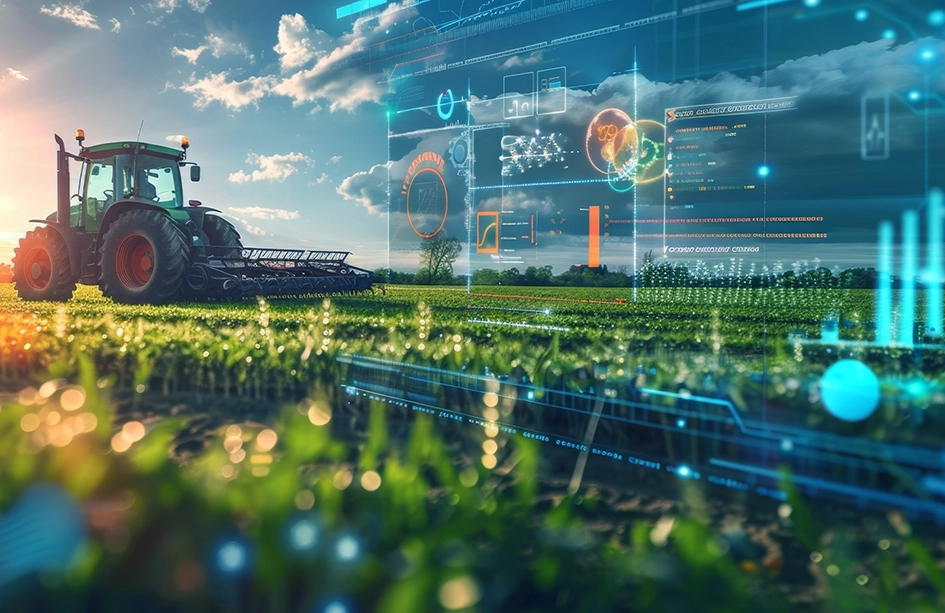
Ask most people to picture the future of farming and they instinctively start with the hardware: a wider combine, a more powerful tractor, or a machine clever enough to steer itself down a field at three in the morning. This reflex makes sense, because for the better part of a century, the stories of mechanisation and the stories of agriculture have been so closely linked.
But while a better machine can do the same job faster, there's one crucial thing it can't do: it can't tell you whether the job needs doing in the first place. That judgement – when to irrigate, when to harvest, which animal to treat – is where the real gains now sit, and it depends entirely on information that can be captured in the field and trusted to reliably and safely reach wherever the decision is made.
The productivity that matters now comes from information rather than raw power. It comes from knowing precisely what is happening in a field, a grain store or a herd at the moment it happens, and being able to intervene before a problem hardens into a loss. A soil probe that distinguishes between irrigation that is worthwhile and irrigation that is simply waste, or a grain monitor that catches a rising temperature in one corner of a store before the whole crop is at risk, is a highly effective early-warning system. Adoption of these technologies is climbing, but it remains far from universal: Defra's figures show well under half of farms using them, and weak rural connectivity is part of the reason.
Getting the data through
Every one of these tools depends on a connection good enough to carry its data off the farm. A sensor that cannot report is no more than an expensive thermometer nobody reads, and even the most sophisticated autonomous machine becomes useless the moment it loses contact with the system directing it. We're comfortable talking about these devices, but so little is said about the connections between them, and yet it is the connection, not the device, that determines whether any of the hardware earns its keep.
Take our customer LH Agro for example. Its core business is auto-steering, which guides tractors and combines accurately across a field. To reach the highest accuracy, LH Agro delivers a real-time correction signal (RTK) to machines over cellular networks.
This is the point at which farming finds itself exposed in a way that many other industries are not. The countryside is the last place in Britain where a working connection can be taken for granted. Recent National Farmers' Union research found that only around a fifth of farmers enjoy a reliable mobile signal across their entire holding, and that nearly one in ten have no 4G or 5G coverage at all. A third have a fibre line, compared against well over half of premises nationally, while close to one farm in twelve has no internet connection of any kind. The infrastructure beneath them is changing, too. The 3G networks that many older devices depended on have already been switched off; the copper telephone network that has served rural Britain for decades is being retired ahead of the move to digital lines in 2027; and the national targets for gigabit broadband and 5G have slipped to 2032. No farm can run a data-led operation on a connection that fails at the bottom of the back field.
The constructive response is not to wait for the fibre van, which across much of the country is not coming, or at least not any time soon. It is to abandon the assumption that a fixed line is the only serious way to move data off a farm. A dedicated mobile or fixed-wireless connection can now be placed precisely where the data is generated – at the grain store on the far side of the yard, for example – rather than wherever the broadband happens to terminate, and in those settings, it is frequently not the compromise but the better piece of engineering. The error many businesses make, in farming and well beyond it, is to treat connectivity as something to be assembled cheaply from whatever consumer broadband and domestic Wi-Fi can be pressed into service, when what the situation actually demands is a single connection that has been designed for the job and managed as one.
But every device added to a network is also a door, and the exposed surface of a farm grows with each sensor, camera and controller bolted on to it. The same link that carries a temperature reading out of a grain store will, if it is left open, carry something far less welcome in the other direction. In addition, a dynamic IP address can also become a door to a network.
Keeping everything else out
Agriculture has already become a target: the 2021 ransomware attack on JBS, among the largest meat processors in the world, halted plants across several countries and was resolved only by a reported $11 million payment, and the FBI has warned that ransomware operators regard food and agriculture as soft, high-value targets. Independent reviews of agricultural technology keep highlighting the same failings, from devices shipped with weak authentication to data sent unencrypted to controllers and left reachable from the open internet by anyone curious enough to scan for them. If food security is national security, as governments repeatedly insist it is, then the systems that grow, store and move that food are critical infrastructure, whether or not they are yet treated as such.
Earlier this year, we launched a live honeypot cyber attack tracker – which can be viewed in real time here - revealing the relentless scale of automated attacks targeting publicly exposed IP addresses. In just 24 hours (April 13-14, 2026), Spitfire’s monitoring system recorded more than 71,000 attack attempts against a single public IP address. It demonstrates the scale of the challenge.
So, the instinct is to connect a device first and protect it afterwards: expose it to the internet, build a wall around it, and hope the wall holds. I would argue the logic runs the wrong way. A device that is never visible on the public internet in the first place cannot be discovered by the automated scanning that attackers use to find exposed equipment, and security designed and built-in at the outset is invariably cheaper and more durable than security retrofitted under pressure. The stronger approach is to keep connected equipment off the public internet altogether, to carry its traffic across a private network it never has to leave, and to partition it so that the compromise of a single device is not the compromise of the whole farm. Framed this way, reliability and security stop being two separate problems and become one problem observed from two sides: whether the right data can get through, and whether everything else can be kept out. Both are properties of the connection, which is precisely why the connection warrants more thought than it is usually given.
The decisive advantage over the coming decade will belong to the farm that understands itself most precisely, from the moisture in its soil to the health of its stock and can act on that understanding faster than the weather, the market, or the disease working its way through the herd.
All of that rests on data that can be trusted to arrive, and to arrive safely. Connectivity is not the plumbing concealed behind clever technology; it is what decides whether clever technology