
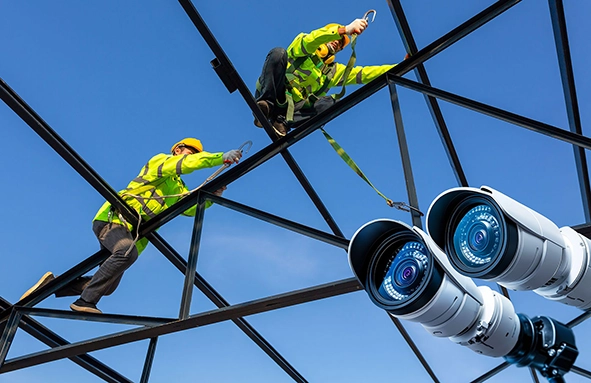
A construction site can change considerably over the course of a project. Areas open and close, equipment moves, and temporary works come and go. The technology supporting the site has to operate within those changing conditions.
Take CCTV. Across construction, roadworks and traffic management, cameras may need to be installed quickly, moved between locations and operated without fixed-line connectivity. They also need enough bandwidth for video, low enough latency for live monitoring and a reliable connection despite variations in mobile coverage.
That places considerable responsibility on the connectivity architecture beneath the cameras. The available mobile networks, the route taken by the data, the way connections are secured and the management of SIM usage can all affect how well the system performs once deployed.
Coverage is only part of the requirement
Construction sites do not always have access to reliable fixed connectivity, particularly during the early stages of a development or on temporary projects. Mobile connectivity allows CCTV systems to be deployed without waiting for permanent infrastructure.
Coverage, however, varies between networks and locations. Multi-network SIMs can provide greater resilience by allowing a device to connect through more than one mobile network. Some roaming-based services route data internationally even when a device is being used in the UK.
For CCTV transmitting large volumes of video, that routing can affect performance. If traffic leaves the UK before returning to UK-based infrastructure, the additional distance can introduce latency. That may have little consequence for occasional sensor readings, but live CCTV is much more sensitive to delays.
A single-network SIM can provide a more direct route and potentially lower latency, although the camera then depends on the coverage of one network. That becomes more restrictive when equipment is regularly moved between sites.
Keeping CCTV within a private network
The connectivity architecture also determines how much of the CCTV environment is exposed to the public internet.
Giving individual cameras public IP addresses can make remote access (required for example for firmware updates or configuration changes) straightforward, but it can also make those devices visible to internet-based scanning and unauthorised access attempts. As the number of connected cameras grows, so does the number of endpoints that have to be protected individually.
Private networking provides another approach. A dedicated MPLS network, for example, can connect SIMs within the cameras directly to the infrastructure receiving and processing their footage, without requiring the cameras themselves to be reachable over the public internet.
The application server can form part of that same architecture. It might be hosted within the connectivity provider's network, in a customer data centre or in a cloud environment connected into the private network. Fixed-line connections can then bring the users accessing the CCTV platform into that network as well.
This allows traffic to remain within a controlled network path from the SIM in the camera, through to the application server and on to the people using the system. It also gives the organisation greater control over which systems can communicate with the cameras and how data moves between them.
Combining performance with resilience
The camera still needs a reliable mobile connection wherever it is deployed.
A dual-IMSI architecture provides one way of combining direct routing with network resilience. An IMSI identifies a mobile subscriber on a cellular network. With two IMSIs available, a SIM can use a primary mobile identity under normal conditions and move to a secondary identity if the primary network is unavailable.
Under the primary IMSI, traffic from a UK-deployed camera can be routed within the UK before reaching the private network and application infrastructure. This avoids the additional international routing associated with some roaming arrangements and can help reduce latency.
If that network becomes unavailable, the secondary IMSI can provide access through another mobile network. Traffic may then take a different route back to the UK, but the camera can remain connected rather than losing service altogether.
For CCTV equipment moving between construction sites, that provides a way to preserve the performance benefits of direct primary routing while retaining an alternative when local coverage changes.
High-data CCTV changes the economics
Video also creates different requirements around data consumption.
A CCTV unit can generate substantially more traffic than many other connected construction technologies. Usage will depend on camera configuration, recording settings and how frequently footage is accessed remotely, but the volumes involved can be significant.
Managing each SIM against a small individual allowance can make costs difficult to predict when cameras have different usage patterns. Pooling data across the estate can provide more flexibility by allowing consumption to be shared between devices.
Visibility is equally important. Operations teams need to know which SIMs are active and how much data they are consuming. Centralised management can provide near real-time usage information, helping teams identify abnormal consumption before it leads to unexpected costs or disruption.
Building the whole CCTV environment around the network
Remote construction CCTV depends on more than finding a mobile signal. The connection has to carry high volumes of video reliably, route that traffic efficiently, protect the devices themselves and continue operating when equipment moves to another location.
Bringing the cameras, application infrastructure and user connections into the same private network provides a way to manage those requirements as one architecture. UK-based primary routing can support performance, multi-network fallback can provide resilience, and centralised SIM management gives operators visibility across the estate.
The result is a CCTV environment in which connectivity extends from the camera on site through to the server processing the footage and the user accessing it. For a system expected to operate across temporary and changing locations, that underlying architecture is a fundamental part of how reliably the CCTV service works.